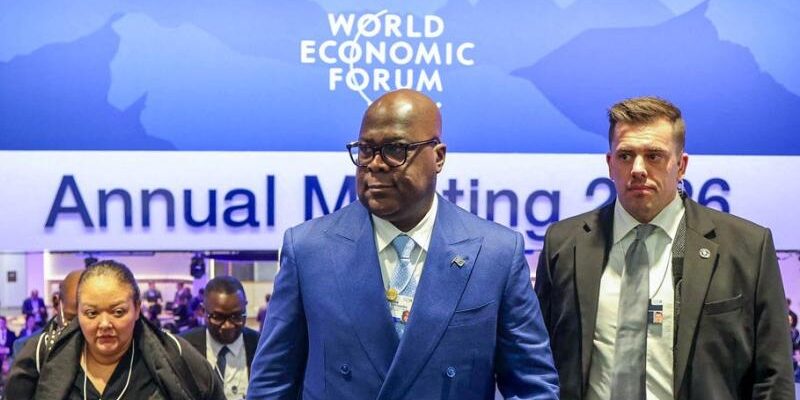
Tshisekedi Positions DRC as Strategic Partner in Global Energy Transition at Davos
At Davos, President Tshisekedi Calls for Fair Mineral Partnerships and Local Value Creation in the DRC
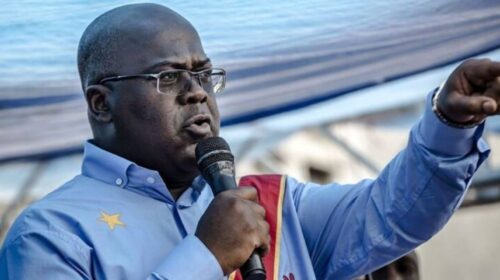
President Félix Tshisekedi is among the guests of honour at the 56th annual meeting of the World Economic Forum (WEF), taking place in Davos, Switzerland, from Monday, January 19 to Friday, January 23, under the theme “A Spirit of Dialogue.” This year’s forum is marked by exceptional diplomatic engagement, with more than 50 heads of state and government expected to attend.
The Davos meeting serves as a high-level platform bringing together global political leaders, business executives and civil society representatives to address pressing international challenges.
At the forum, the Democratic Republic of Congo (DRC) is positioning itself as a “solutions country” for Africa and the wider world. Speaking on Wednesday, January 21, during a session titled “Strategic Partnership on Minerals and Investments,” Tshisekedi stressed that the success of the global energy transition depends on shared responsibility, fairness across the value chain and sustained commitment from all stakeholders.
“Success also requires reliable, ethical and responsible supply chains. In this regard, the DRC intends to play its full role—not as a mere supplier of raw materials, but as a strategic player in this transition. The time has come to replace dependence with partnership,” Tshisekedi said in his opening remarks.
To give substance to this vision, the Congolese president outlined three key commitments. The first focuses on security through diversification. He called for substantial investment in the discovery of new mineral deposits, arguing that “the security of your markets depends on the diversity and robustness of our supply sources.”
The second commitment centres on prosperity through local value addition. Tshisekedi emphasised that energy security cannot be separated from economic security and declared that the era of purely extractive models is over.
“We are calling for the relocation of value-added segments—refining and component manufacturing—directly to the heart of production areas. By creating a skilled local workforce, we can stabilise global supply and ensure the sustainability of processing.
Local value creation must no longer be viewed as an option, but as a strategic imperative. By processing our resources on our own soil, we move from an extractive economy to one of sustainable industrialisation, ensuring that the wealth generated primarily benefits our populations while strengthening the resilience of global value chains,” he said.
The third commitment relates to financial and industrial innovation. Tshisekedi highlighted the need to move beyond traditional development models by forging partnerships based on innovative financial mechanisms capable of mobilising long-term capital for integrated projects and industrial development corridors.
He used the platform to invite international partners to engage with the DRC through mutually beneficial, long-term partnerships. According to Tshisekedi, the country is open to investors and governments willing to share risks and adopt a long-term perspective.
“I therefore call on our international partners to work with us within a framework of collaboration based on mutually beneficial partnerships, respectful of state sovereignty and conducive to shared prosperity, in order to build a fairer and more sustainable mineral value chain for future generations. Africa is no longer simply waiting to be heard—it is ready to build.
The DRC is open to those with a long-term vision who are prepared to take risks alongside us. Together, let us turn the mineral challenge into a driver of universal prosperity,” the Congolese president said.
This appeal comes just weeks after the signing in Washington of a strategic partnership agreement between the United States and the DRC.
The agreement is intended to accelerate priority industrialisation projects, secure supply chains for critical minerals and support the development of key infrastructure.
Previously described as a “mining deal,” the partnership forms part of the broader Washington agreements concluded under the Trump administration.
However, the agreement has not achieved consensus within the Congolese socio-political landscape and continues to attract criticism. While the government presents it as evidence of strong bilateral trust, Fulgence Muteba Mugalu, Archbishop of Lubumbashi in Haut-Katanga, has denounced the deal as a sell-out.
He argues that it prioritises regime survival over the country’s long-term interests and risks undermining national development and the well-being of future generations.