
Sweden and Zambia Forge Strategic Alliance for Sustainable Mining and Energy
A New Era of Green Industrial Growth Rooted in Innovation, Technology, and Shared Values
Sweden and Zambia have reaffirmed their commitment to a dynamic partnership focused on sustainable mining, renewable energy, and inclusive industrial development.
Anchored in innovation and responsible resource management, this collaboration aims to accelerate green transformation across both nations.
Shared Vision for a Sustainable Future
Swedish Ambassador Johan Hallenberg emphasized the enduring relationship between Sweden and Zambia, built on democratic values and mutual respect.
He noted that both countries are rich in natural resources, a common strength that underpins deeper cooperation in mining and energy.
“Sweden sees Zambia as an all-weather friend and a key partner in promoting sustainable development,” Hallenberg said. “Our cooperation spans mining, energy, climate, governance, and human rights all anchored in our shared vision for a fair and green transition.”
Swedish companies have long contributed advanced technologies to Zambia’s mining sector, supporting not only business but also environmental stewardship, research, and innovation.
Hallenberg reaffirmed Sweden’s readiness to expand collaboration that delivers long-term economic and social value.
Sweden’s Commitment to Green Growth
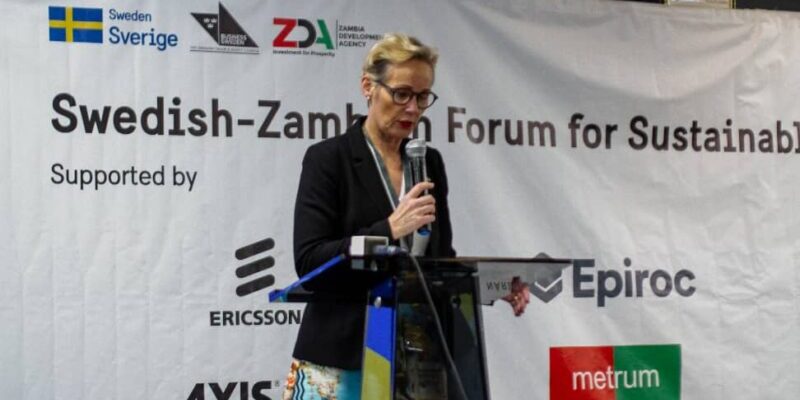
Camilla Mellander, Sweden’s Director General for Trade, highlighted the evolution of bilateral ties—from traditional development aid to trade-driven partnerships focused on green industrialization.
She noted Sweden’s leadership in European mining, producing approximately 90% of the EU’s iron ore and 10% of its copper.
Mellander underscored Sweden’s ambition to become the EU’s most sustainable mining nation, while Zambia diversifies its economy through renewable energy and responsible mining.
“Sweden wants to be a partner to Zambia in its transformational journey,” Mellander said. “Our companies bring innovation and responsible business practices that can help drive Zambia’s next phase of industrial growth.”
This partnership aligns with global efforts to reduce carbon emissions, improve energy efficiency, and promote circular economies.
Both countries recognize mining as a key economic driver one that must evolve to meet environmental and social goals.
Driving Green Transition Through Partnership
Mellander spotlighted Sweden’s leadership in low-emission technologies, digitalized mining, and clean energy solutions.
She cited the Zambia Mining Nexus Program a Swedish-supported initiative that strengthens governance, transparency, and environmental management in Zambia’s mining sector.
She also highlighted the Zambia Industrial Training Academy Program, which equips youth with vocational skills in engineering, mechanics, and renewable energy, preparing them for a modern, sustainable economy.
“These initiatives reflect our belief that true transformation requires partnerships,” Mellander said. “We want our engagement with Zambia to generate real value for communities, build human capacity, and support broader development goals.”
Zambia’s Push for Green Energy and Industrial Growth
Copperbelt Minister Elisha Matambo, representing the Ministry of Energy, reiterated Zambia’s commitment to modernizing its energy and mining sectors while tackling climate change and power deficits.
“The demand for green energy is driving development and enhancing value addition in our mineral production,” Matambo said. “We’re integrating sustainable practices across the economy, with mining our largest energy consumer leading the way.”
He invited Swedish companies to invest in Zambia’s expanding renewable energy and green industrial sectors, citing policy reforms and infrastructure upgrades that create a favorable investment climate.
Technology Transfer and the Future of Mining
Minister of Mines and Minerals Development, Paul C. Kabuswe, called for deeper collaboration in technology transfer and innovation, aligned with Zambia’s Eighth National Development Plan.
“Our mining sector must evolve with the times,” Kabuswe said. “Through partnerships with countries like Sweden, we can adopt cleaner technologies, increase productivity, and ensure our resources create lasting benefits for our people.”
He emphasized the potential for Swedish firms to support value chain development in copper—a strategic resource for Zambia’s economy and global clean energy systems.
Building the Next 60 Years of Partnership
Sweden and Zambia pledged to build on six decades of friendship by focusing on sustainable growth, innovation, and inclusive development.
Their partnership is more than diplomatic, a strategic alliance that blends technology, investment, and shared values.
As Zambia positions itself as a regional hub for green mining and renewable energy, and Sweden continues to lead in sustainable technology, their collaboration offers a compelling model for how international partnerships can drive economic growth and environmental responsibility.
By Japhet Lungu; Editing by Constance