

Washington Agreement Between DRC and Rwanda Formalizes Mineral Exploitation, Says Oakland Institute
Washington Agreement 2025: How the DRC-Rwanda Deal Fuels U.S.-Backed Mineral Exploitation
A recent report from The Oakland Institute criticizes the Washington Agreement, signed on June 27, 2025, between the Democratic Republic of Congo (DRC) and Rwanda, calling it a formalization of the ongoing illicit exploitation of the DRC’s mineral wealth by American companies via Rwanda.
The U.S. and the Historical Exploitation of Congo’s Minerals
The report highlights the long-standing strategic importance of Congolese resources to the United States. It notes that “the bombs dropped on Hiroshima and Nagasaki were made from uranium sourced from the Belgian Congo,” underscoring the centrality of Congo’s mineral wealth to U.S. interests.
In 1960, the CIA orchestrated a coup that led to the overthrow and assassination of Congo’s democratically elected Prime Minister, Patrice Lumumba, reportedly out of concern that he would nationalize mineral resources or align them with the Soviet bloc during the Cold War.
During the rule of Mobutu Sese Seko, former president of Zaire (now DRC), the U.S. provided over $400 million in military aid, enabling Mobutu to suppress political opposition. American companies, including Freeport-McMoRan, secured vast mineral deposits, some of which were later sold to Chinese firms in 2010.
The U.S. eventually withdrew support for Mobutu in the 1990s, facilitating his resignation in 1997 while backing Uganda and Rwanda, who had entered eastern DRC during Kabila’s campaign to overthrow Mobutu. Many Rwandan and Ugandan military leaders involved in eastern DRC conflicts received U.S. military training, including Rwandan President Paul Kagame.
Regional Integration or Resource Exploitation?
The report argues that the Washington Agreement’s stated goal of regional integration is effectively the formalization of mineral plundering. It describes this “integration” as the consolidation of mineral supply chains from DRC mines to Rwanda, aligning with American business interests.
The Rwandan Minister of Regional Integration, James Kabarebe, is a former chief of staff of the Congolese army. According to The Oakland Institute, Kabarebe was sanctioned by the U.S. Treasury in early 2025 for facilitating Rwanda’s support for the M23 rebel group, overseeing mineral exports from the DRC, and managing the revenues from these activities.
“The agreement thus institutionalizes the exploitation of Congolese minerals after decades of smuggling by Rwanda,” the report states.
Economic Impacts on DRC and Rwanda
The report highlights the economic consequences of this system for both nations.
Rwanda has experienced significant growth through its mining sector. Between 2017 and 2024, mineral exports rose nearly 500%, from $373 million to $1.75 billion, with gold accounting for $1.5 billion of 2024 exports. The report warns that official figures likely understate the total volume of Congolese gold flowing through Rwanda.
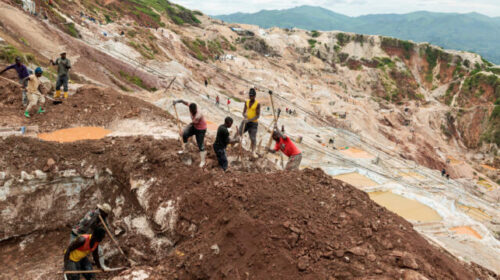
DRC loses an estimated $1 billion annually in revenue due to resource smuggling through Rwanda. While formal trade under the Washington Agreement may reduce these losses, the report notes that the DRC’s larger mineral deposits will continue to be extracted at high social and environmental costs, while Rwanda profits from processing and exporting these resources globally.