
Zambia Backs AfDB President’s Vision for Strengthened African Financial Architecture
Zambia Supports AfDB Initiative to Boost Africa’s Economic Sovereignty and Infrastructure Development
Zambia has reaffirmed its strong support for African Development Bank (AfDB) Group President Dr. Sidi Ould Tah’s initiative to establish a robust African financial architecture designed to enhance the continent’s economic sovereignty.
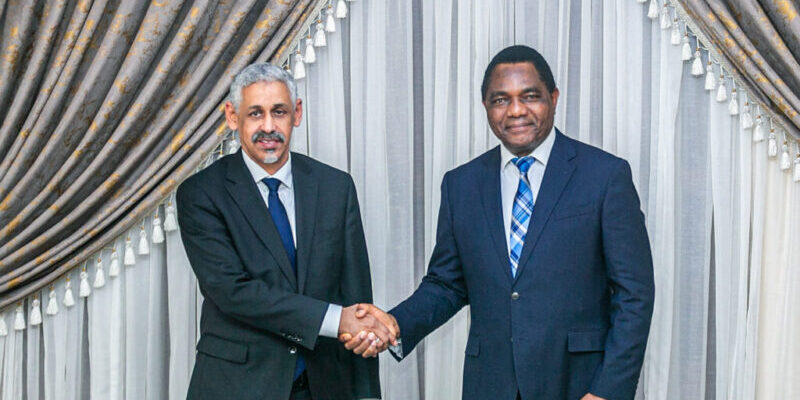
President Hakainde Hichilema expressed this backing during discussions with Dr. Ould Tah at State House, Lusaka, on 9 October 2025, following Zambia’s successful hosting of the third meeting of the 17th African Development Fund replenishment cycle (ADF-17).
The talks highlighted Zambia’s strategic partnership with the AfDB and the country’s growing leadership in Africa’s economic transformation. Dr. Ould Tah commended Zambia for hosting the ADF-17 meeting and for pledging $5 million to the fund, describing the nation’s commitment as an inspiration.
President Hichilema emphasized the importance of reducing Africa’s dependence on external financing and addressing structural imbalances that contribute to high borrowing costs. He noted that global credit assessments often undervalue African assets, keeping capital costs elevated.
As one of the African Union’s Champions of Global Financial Architecture Reform, President Hichilema welcomed Dr. Ould Tah’s push for greater alignment among Africa’s financial institutions, including multilateral development banks and regional funds, to enhance domestic resource mobilisation and blended finance solutions.
The leaders also reviewed progress under Mission 300, a joint AfDB-World Bank initiative to provide electricity access to 300 million Africans by 2030. Zambia, a signatory of the Mission 300 National Energy Compact in January 2025, aims to achieve universal electricity access, secure a 33% share of non-hydro renewable energy, and mobilize $11.9 billion in investment, with 82% expected from the private sector.
“Energy access is the lifeblood of industrialisation,” President Hichilema said, highlighting Zambia’s readiness to extend the compact model to manufacturing and regional value chains.
The discussions further emphasized the strategic role of developing transport and trade corridors to support Africa’s economic integration and industrial growth. Dr. Ould Tah noted:
“By working together, we can turn transport corridors into corridors of prosperity. The AfDB Group will remain a steadfast partner in building infrastructure that connects markets, creates jobs, and powers Africa’s integration.”
Zambia plans to position itself as a land-linked trade hub through investments in the North–South and Lobito transport corridors, both supported by the AfDB. Dr. Ould Tah also praised Zambia’s macroeconomic stability, investor confidence, and projected 6.2% GDP growth in 2025, driven by energy, agriculture, and record copper production.
The AfDB’s 2024-2029 Country Strategy Paper prioritizes energy, agriculture, transport, skills development, and private-sector growth. To date, cumulative AfDB support to Zambia exceeds $900 million, funding transformative projects such as the Kazungula Bridge, Nacala Road Corridor, Livestock Infrastructure Project, and the Science and Technology Education Project, which has bolstered STEM capacity nationwide.
The meeting concluded with a shared commitment to deepen collaboration between Zambia and the AfDB, advancing Africa’s economic sovereignty, integration, industrialisation, and human capital development — the four pillars of Dr. Ould Tah’s strategic vision.