Kamoa-Kakula Sets Ambitious 2026–2027 Copper Production Targets as Dewatering Progress Accelerates
Ivanhoe Mines Projects Up to 540,000 Tonnes of Copper Output by 2027 as Kamoa-Kakula Dewatering Advances
Ivanhoe Mines (TSX: IVN; OTCQX: IVPAF) Executive Co-Chairman Robert Friedland and President and Chief Executive Officer Marna Cloete have announced copper production guidance for 2026 and 2027 at the Kamoa-Kakula Copper Complex, alongside an update on the Kakula Mine’s dewatering and rehabilitation progress.
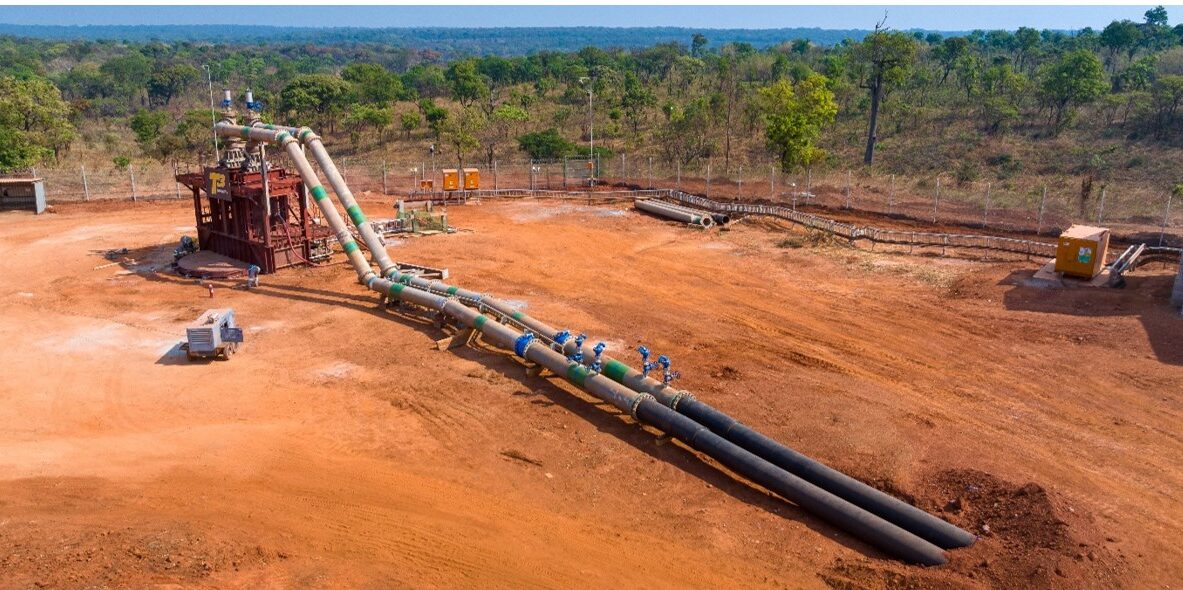
Dewatering at Kakula continues to advance steadily, now approximately 70% complete on the western side of the mine and 60% complete on the eastern side. To date, 13.4 kilometres of underground workings have been rehabilitated, including 4.6 kilometres that were fully dewatered and made safe for resumed operations.
Strong progress on rehabilitation and ongoing mine planning has enabled management to issue copper production guidance of 380,000–420,000 tonnes for 2026 and 500,000–540,000 tonnes for 2027.
The operation continues to target medium-term annual production of roughly 550,000 tonnes. An updated life-of-mine plan remains on schedule for completion in late Q1 2026.
Following the commissioning of the Kamoa-Kakula Copper Smelter on December 1, 2025, copper sales in 2026 are expected to exceed mined production due to the drawdown of approximately y20,000 tonnes of concentrate inventory.
Executive Commentary
Robert Friedland, Founder and Executive Co-Chairman, highlighted the strong recovery:
“The turnaround at Kamoa-Kakula is advancing with confidence. Even during the recovery years of 2025 and 2026, the operation is set to produce around 400,000 tonnes of copper—an extraordinary testament to the world-class nature of this deposit. As we progress through this transition, Kamoa-Kakula and the Western Forelands are poised to become one of the world’s largest, if not the largest, copper production hubs.”
He added that the start of on-site copper anode production represents a transformational milestone for both the project and the Democratic Republic of the Congo.
Marna Cloete, President and CEO, praised the workforce:
“We extend our deepest gratitude to the entire team for their discipline, resilience, and steadfast commitment to safety throughout the dewatering and rehabilitation of the Kakula Mine. Their professionalism has been essential to our progress.”
Improving Copper Grades as Higher-Grade Zones Reopen
Kakula’s updated mine design incorporates optimized pillar layouts and extraction sequencing based on geotechnical recommendations. Mining rates on the western side have risen to roughly 350,000 tonnes per month, or 4.2 million tonnes annually.
Early mining has targeted higher-elevation zones with lower grades, but crews are now advancing into the central high-grade area as water levels recede. Grades are expected to rise to 3.5–4.0% beginning mid-December.
Selective mining is expected to resume on the eastern side during Q1 2026. Combined mining rates at Kakula are projected to reach 450,000 tonnes per month (5.5 Mtpa) by the end of that quarter. Development toward a new eastern mining block is also underway, with first ore planned for mid-2026.
Kakula output is expected to total ~6 Mt of ore in 2026, increasing to 7–8 Mt in 2027, at grades of 3.5–4.5%. In 2026, approximately 70% of ore will come from the western side, with eastern contributions increasing in 2027.
Mining Rate at Kamoa Mines to Exceed 10 Mtpa in 2027
Combined output from the Kamoa 1, Kamoa 2, and Kansoko mines is projected to increase from 6.5 Mt per year to 8.5 Mt in 2026 and more than 10 Mt in 2027, at an average grade of approximately 2.5% copper. Productivity improvements will be supported by new infrastructure, enhanced access, and equipment redundancy.
This expanded production rate will supply the Phase 3 concentrator and provide supplementary feed for the Phase 1 and 2 concentrators.
Processing Capacity Increasing to 17 Million Tonnes Annually
The Phase 1 and 2 concentrators will continue processing ore from Kakula’s western zone and surface stockpiles until Q1 2026, after which increasingly more ore will come from the eastern zone and Kamoa. About 2 Mt of Kamoa ore will be processed in 2026, rising to 2.5 Mt in 2027.
Phase 1 and 2 have demonstrated a combined capacity of 10.5 Mtpa, while Phase 3 has consistently operated at 6.5 Mtpa. Recoveries for Phase 1 and 2 are expected to rise to ~95% following the completion of Project 95 in Q2 2026. An enhancement project for Phase 3 recoveries (targeting ~92%) is under evaluation.
Life-of-Mine Update on Track for Q1 2026
Work on the updated integrated development plan—covering all phases at the planned 17 Mtpa processing rate—is progressing on schedule. A Phase 4 expansion scenario, adding another 6.5 Mtpa through a duplicate Phase 3 concentrator, will also be evaluated.
As the Kakula recovery plan is completed, annualized production is expected to return to approximately 550,000 tonnes over the medium and long term.
Dewatering Progress Exceeds 60% in Stage 2
Stage 2 dewatering began in early September 2025, using high-capacity submersible pumps capable of 2,600 litres per second. The mine was successfully divided into eastern and western dewatering zones in November.
As of early December:
- Western zone dewatering is 70% complete, with full completion expected by the end of January 2026 during Stage 3 dewatering.
- Eastern zone dewatering is 60% complete, with pumps successfully lowered to continue reducing water levels into Q1 2026.
More than 2,200 megalitres of water remain below the Stage 2 pump levels and will be removed gradually using reinstated underground pump stations. This flooded area does not impede near-term production ramp-up, as initial eastern mining will focus on a new area beyond a barrier pillar.
2026 & 2027 Copper Production Guidance
| Year | Contained Copper (tonnes) |
|---|---|
| 2026 | 380,000 – 420,000 |
| 2027 | 500,000 – 540,000 |
Guidance reflects current assessments of operational risks and rehabilitation progress. Kamoa-Kakula produced 316,395 tonnes of copper in concentrate during the first nine months of 2025 and remains on track to meet its revised 2025 production target of 370,000–420,000 tonnes.
Capital expenditure guidance for 2025 and 2026 remains unchanged. Cash cost guidance for 2026 will be released with the full-year 2025 financial results in February 2026.